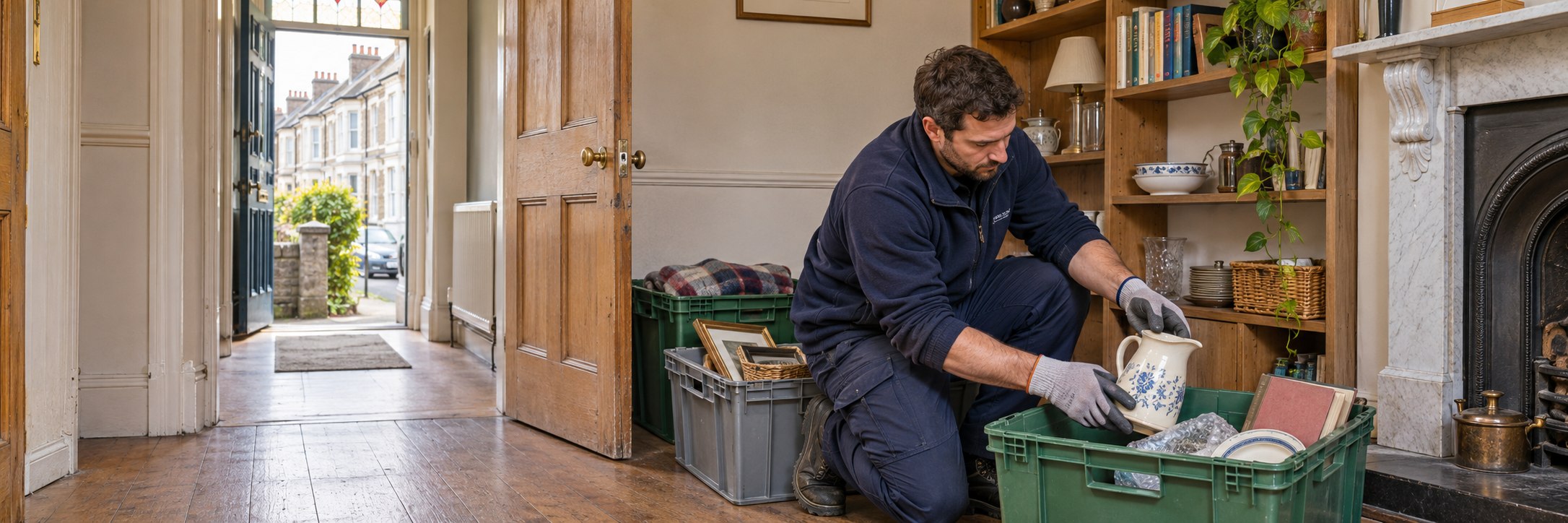

A household facing a heavily cluttered home in Bristol may need a usable kitchen or a clear route to the bathroom before it needs an entire property cleared. We begin by asking the resident or their representative which change would make the greatest difference. Together we identify possessions to keep, decide who can authorise removal and choose a manageable first area. Once that space is accessible, the team can assess the surfaces and agree the next stage with the people who use the home.
Our work is organised around a clear scope, suitable protective measures, a method for recording decisions and a realistic sequence of sorting, removal and cleaning. The scale of the intervention may range from one crowded room to a whole property that needs phased access. We discuss the condition of the kitchen, bathroom, stairs and exits, whether anyone still lives there, and whether there are issues such as damp, pests or unsafe electrics that require attention from another specialist. These details help distinguish ordinary decluttering from a complex clean and prevent unnecessary disturbance to unaffected areas.
Agree who makes decisions about possessions and access
Before arranging a clearance, establish who owns or occupies the property and who can authorise decisions about its contents. The resident may want to remain involved in sorting and identify what must be kept. Where a relative, executor, landlord or managing agent is coordinating work, their authority and instructions should be clear. A cleaner should not decide the fate of photographs, documents, medication, keys, jewellery or equipment simply because they appear among clutter. We agree categories for retention, review and disposal, then decide how uncertain items will be set aside for a named person to inspect. This reduces the risk of irreversible mistakes and makes the pace of work more manageable.
Access arrangements matter in Bristol terraces, converted houses, flats above shops and managed blocks. Narrow staircases, shared entrances, limited parking and neighbours who use the same hallway can affect the order of removal. We ask about keys, lift rules, loading restrictions, available utilities and a suitable route for equipment and bagged material. If a room cannot be entered safely, the plan begins by opening a controlled route rather than moving everything at once. Privacy is handled through ordinary practical choices: a sensible arrival time, a discreet entrance where possible and a limited briefing for people who need to know about access.
Assess the condition of each room before choosing a method
Clutter can conceal hazards and also protect surfaces from view, so an initial description is useful but never a substitute for inspection. We look at the depth and stability of stored items, the condition of walkways, whether doors and windows open, signs of water intrusion and the state of kitchens and bathrooms. Loose electrical leads, broken glass, sharp metal, damaged furniture and heavy stacks can affect how work proceeds. Where there are needles, suspected asbestos, severe structural concerns or another specialist hazard, the appropriate assessment and controls must be arranged before routine cleaning continues. The scope should reflect what is actually present rather than a standard package.
Photographs provided by the authorised contact can help us discuss the likely volume and equipment, provided taking them is safe and respectful. A written room-by-room list is often more helpful: areas to retain, contents requiring review, appliances to remain, access to water and electricity, and rooms where cleaning is especially urgent. We can then explain which tasks are included, which may depend on what becomes visible during sorting, and how a change in scope will be agreed. This is particularly useful when relatives live outside Bristol or an agent is coordinating several parties.
Sort belongings methodically and preserve important items
A labelled review box gives uncertain items a destination without forcing an immediate decision. Someone helping a relative in Fishponds might agree that all keys, post and photographs go into that box while the first cupboard is emptied. At the end of the visit, hand it to the named person and record the next room to tackle. For a vacant property where the sorting decisions have already been made, house clearance in Bristol follows a different brief.
A workable sorting system needs enough space to prevent the keep, review and discard streams from becoming mixed. We may start with an entrance, a landing or another small zone that creates a safe route through the property. Items can then be grouped by room or agreed category, with uncertain belongings kept accessible for the decision maker. Documents, photographs, digital devices, personal records and valuables receive particular care. The person responsible for the property should decide whether anything is to be archived, donated, recycled or removed; an assumption based on appearance can be costly and distressing.
Phased work can be preferable where the resident wants to participate or has limited time to make decisions. It can also help when storage space is scarce. We discuss how items to be retained will be protected from dust and cleaning products, whether boxes need labels, and where they will be placed at the end of each visit. A clear stopping point is useful: for instance, restoring a functional kitchen route before moving to a bedroom. The method should leave the property more usable after every stage rather than shifting clutter from one room into another.
Plan removal and disposal without confusing it with cleaning
House clearance and deep cleaning are connected tasks but they have different labour, equipment and disposal needs. A bulky item may require dismantling or more than one person to move it, while bagged waste needs a suitable collection route. The estimate should account for the amount and type of material, stairs, carrying distance, parking and the time needed for careful sorting. We discuss lawful disposal arrangements and identify items that cannot go into an ordinary waste stream. If a specialist collection is needed, that should be explained before work is priced or scheduled.
Donation and recycling may be possible for suitable possessions, but neither should be promised for items that are contaminated, damaged or not accepted by a receiving organisation. We avoid presenting disposal as an automatic consequence of a hoarding clean. The agreed objective may instead be to clear exits, restore access to sanitary facilities and retain as much as possible. Where the property is vacant and the authorised person requests a fuller clearance, the same care with documents and valuables still applies. A record of what is retained and what is removed makes the handover easier.
Clean surfaces only when they can be reached properly
Removing bags and boxes reveals the condition of floors, skirting, cupboards, worktops and sanitary fittings. Dust can be extensive in rooms that have not been accessible for years. We sequence the work so that debris removal and dry cleaning precede appropriate wet cleaning, while avoiding unnecessary spread into clean areas. The method depends on the surface: a sealed hard floor, carpet, unfinished timber and a painted wall cannot all be treated in the same way. We identify visible stains, damaged finishes and areas that may need repair rather than describing every mark as removable by cleaning.
 Kitchens and bathrooms often need more detailed attention once access is restored. Surfaces may have grease, food residue, scale or long-standing deposits; appliances may need to be assessed separately. The work may include cupboards, fixtures, floors and accessible ventilation grilles, depending on the agreed scope. If there is an active leak, pest activity, damaged wiring or a failed appliance, cleaning should be coordinated with the relevant repair or specialist service. We do not claim that a cleaned surface is sound when the underlying material remains damaged.
Respond proportionately to odour, damp and contamination
Odour may come from spoiled contents, absorbent furnishings, damp building materials or an ongoing source that cleaning alone cannot remove. We first identify and remove the source where authorised, then assess which surfaces can be cleaned and which materials may need further attention. Fragrance is not a substitute for this process. The same principle applies to damp: if water is still entering the building, a cleaning visit cannot resolve the cause. We can describe what is visible and suggest that the responsible property specialist investigate before costly finishing work is planned.
Where biological contamination is suspected, the area should be assessed on its own merits and the method adapted to the material and extent. Protective equipment, containment and disposal arrangements may differ from those for an ordinary deep clean. We will explain limitations if porous finishes or inaccessible cavities may retain contamination. A promise that every odour or stain will disappear without inspection would be misleading. The useful outcome is an agreed, evidence-based scope that deals with the source, protects unaffected rooms and identifies repairs or replacement where cleaning is insufficient.
How sorting time and room access affect a hoarding clean
There is no reliable price from floor area alone. Two homes of the same size can require very different work if one contains mostly sorted belongings and the other has blocked rooms, heavy furniture and inaccessible fittings. Labour time, volume for removal, handling of fragile possessions, number of visits, protective measures, parking, stairs and the level of detailed cleaning all affect the estimate. A property in Clifton with several flights of stairs may present different logistics from a ground-floor home in Bedminster or a managed building in Filton. These are planning factors, not fixed local surcharges.
Tell us which rooms are involved, whether the property is occupied, the approximate quantity of material to review, and what outcome is needed. Is the priority safe access, a partial sort, a full clearance, a deep clean or preparation for repairs? If photographs are available, send them only if obtaining them is safe. We can explain what information is needed for a useful quotation and whether an in-person assessment is appropriate. Any estimate should state its assumptions, the tasks included and how unexpected findings will be handled. This allows the person authorising the work to compare scopes rather than vague promises.
Coordinate with residents, families, landlords and agents
The best working arrangement depends on who is living in the property and who will be present. Some residents prefer to guide sorting in person; others ask a trusted contact to make decisions. Families may need time to review documents or sentimental items. Landlords and agents may be focused on access, inventory and subsequent repairs. We agree a single point of contact for decisions during the work and a method for recording any changes. Where several people have different expectations, a clear written scope prevents the cleaning team from being asked to make choices it cannot properly make.
In a shared building, the sequence should account for communal routes, noise, collection times and the need to leave exits clear. For an occupied home, we can discuss which room must remain usable during each stage. For a vacant property, the handover may require photographs of completed areas and notes about remaining defects. Cleaning and repair are different responsibilities; a report can distinguish a surface that has been cleaned from flooring, plaster or fittings that still require a tradesperson. This distinction helps everyone plan the next step without overstating what has been achieved.
Local coverage across Bristol and nearby communities
Nova Clean Bristol discusses work in central Bristol, Clifton, Redland, St George, Fishponds, Bedminster and surrounding neighbourhoods, as well as nearby communities such as Filton, Keynsham, Pill and Portishead. The postcode, access conditions and nature of the work determine the practical arrangements. Bristol's older terraces, basement rooms, converted houses and newer apartment blocks all bring different routes and restrictions for clearance. A local description of the property is more useful than a generic request for a whole-house clean.
To start, provide the postcode, the number of rooms affected, whether anyone lives there and the outcome you want to achieve. Tell us about stairs, parking, keys, any known water or pest issue and the person who will decide what is kept. We will discuss a sensible assessment and a scope that respects the people and belongings involved. You can use the cleaning quote form or call 0845 52 805 20. The conversation can begin with a small, achievable first stage if the full extent of work is not yet clear.